
What are the most beautiful towns in Malaga?
When you start searching for beautiful towns in Malaga online, the same list appears repeated on thirty different websites: the same five photos, the same clichéd phrases and almost no practical information. The result is that many families end up trying to fit three towns into a Saturday, arriving late for lunch, with no parking and with the feeling that they have not really seen any of them properly.
This guide is designed the other way around. We have selected eight towns to visit in Malaga that really work: they have reasonable access by car, offer something specific to do once you are there, have decent places to eat and can be combined with other plans in the area without having to get back in the car three times.
There are coastal towns, inland towns, classic white villages, one with a colour you would not expect, and others that are less touristy, where authentic Malaga life can still be found. At the end of each one, you will find a practical fact sheet with the information you really need: where it is, how to get there, parking, recommended visit duration and what it can be combined with.
Frigiliana: the white village that still looks like a real postcard
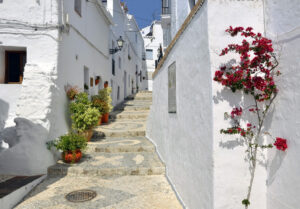
Frigiliana appears on almost every list of the most beautiful villages in Spain, and for once, its fame is well deserved. The Moorish quarter in the upper part of the village, with its cobbled streets, whitewashed façades and blue flowerpots, is exactly what you expect from a textbook Andalusian village, but without the theme park feeling that other places already have.
What other guides do not tell you
The lower part, next to the road, is where you will find shops, terraces and the most touristy atmosphere. The upper part begins around the church, and that is where it is really worth getting lost. If you are only going to spend two hours there, head straight up to the Moorish area and leave shopping for later.
Another detail that saves trouble: parking in the village is very limited. There are two public car parks at the entrance and it is best to leave your car there. Driving into the centre streets is a terrible idea, especially at weekends.
| Fact | Detail |
| Where | Axarquía, 7 km from Nerja |
| Distance from Malaga | Approx. 55 km / 50 min by car |
| Recommended duration | 2 to 3 hours |
| Parking | Public car park at the entrance to the village |
| Must-see | Walk up through the Moorish quarter to the upper viewpoints |
| When to go | Spring and autumn. Avoid midday in July-August |
| Combine with | Nerja, Nerja Cave, Burriana Beach |
Fuente de Piedra: the beautiful town in Malaga with the flamingo lagoon
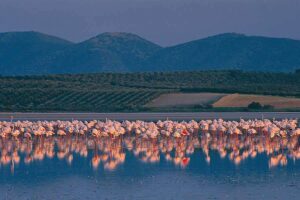
Fuente de Piedra is one of those towns that few guides to beautiful towns in Malaga include, and that is a mistake. It has a small, quiet and very well-kept historic centre, but what really makes it a must-stop is what lies next to it: the Fuente de Piedra Lagoon, the largest wetland in Andalusia and one of the most important sites in Europe for the breeding of the greater flamingo.
Why it deserves to be on this list
The scene in spring is difficult to describe if you have not seen it: thousands of pink flamingos in a saltwater lagoon with the mountains in the background, purpose-built observatories and a very well-organised visitor centre. It is not a tourist attraction “designed” for visitors: it is a natural phenomenon that happens every year between February and July, and few places in Europe can offer it.
The town itself is the other part of the plan. Small, flat, largely pedestrian in the centre, with the church of Nuestra Señora de las Virtudes presiding over the main square and local bars where you can eat regional produce without paying tourist prices. It is exactly the contrast that the lagoon visit needs. Some things you should bear in mind about Fuente de Piedra:
- The lagoon dries up in summer. If you go in August, you will probably find it without water and without flamingos. The best time is from February to June, peaking between April and May.
- Bring binoculars. The observatories are well designed, but the flamingos are not “right next to you”: seeing them properly makes all the difference.
- There are several short trails around the lagoon, flat and suitable for all ages. The most recommended one starts at the visitor centre itself.
- Access to the town and lagoon: free.
The plan that really works
If you come to Fuente de Piedra, the winning format is to combine the lagoon with a nearby outdoor plan. The most complete option, especially with children, is to link the visit with Laberintus Park, which is in Humilladero, just 5 minutes away by car. The best-fitting plan is:
- First thing in the morning at the lagoon: the flamingos are more active, the light is perfect for photos and it is not hot yet.
- “José Antonio Valverde” Visitor Centre: free entry, exhibition about the wetland and telescopes available. Ideal for helping children understand what they are seeing.
- Midday in the town: a relaxed lunch on one of the terraces in the centre.
- Afternoon at Laberintus Park: the plant maze and play areas round off the day perfectly.
| Fact | Detail |
| Where | Antequera region, inland Malaga |
| Distance from Malaga | Approx. 75 km / 1h by car |
| Recommended duration | Half day (lagoon + town); full day combined with Laberintus Park |
| Must-see | Fuente de Piedra Lagoon, Visitor Centre, old town |
| Parking | Free at the visitor centre and in the town |
| When to go | From February to June to see flamingos. Avoid August (dry lagoon) |
| Combine with | Antequera, El Torcal and Laberintus Park in Humilladero |
Ronda: the beautiful town in Malaga that impresses you from the first minute
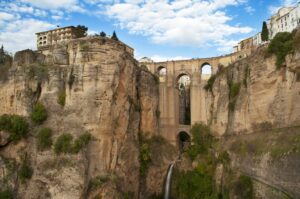
Calling Ronda a town almost does not do it justice: it has more than 30,000 inhabitants and a historic centre that rivals many cities. But its gorge, the 100-metre drop of the Puente Nuevo and the view from Plaza de España are reason enough to include it in any list of beautiful towns in Malaga, even if it is technically a city.
The mistake almost every visitor makes
The classic photo of the Puente Nuevo is not taken from on top of the bridge, but from below. To see it properly, there are two options: walk down the Tajo trail (about 20 minutes down and another 25 back up; not suitable for everyone) or stop at the Mirador del Viento, which is much more accessible. Many people leave Ronda without having really seen what they came to see.
Another point: parking in Ronda is expensive and fills up early. On weekends and public holidays, it is best to arrive before 11:00 or accept from the start that you will have to leave the car farther from the centre and walk 10 minutes.
What to see besides the bridge
- Bullring: one of the oldest in Spain.
- Arab baths: the best preserved on the Iberian Peninsula, in the San Miguel neighbourhood.
- Alameda del Tajo: a tree-lined promenade with views, ideal for taking a break.
| Fact | Detail |
| Where | Serranía de Ronda |
| Distance from Malaga | Approx. 100 km / 1h 30 min by car |
| Recommended duration | At least half a day; a full day is worth it |
| Parking | Martínez Astein car park or El Castillo car park |
| Must-see | Mirador del Viento + Puente Nuevo + Bullring |
| Food | Oxtail or mountain-style cuisine in the old town |
| When to go | All year round; in winter it can be quite cold |
Mijas Pueblo: the easiest white village to visit on the coast
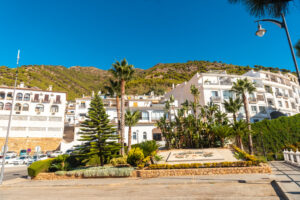
If you are looking for a classic white village without steep climbs or long routes, Mijas Pueblo is the most comfortable option on the Costa del Sol. It is largely pedestrianised, has plenty of shade between its narrow streets, and the views from Plaza de la Constitución are among the best in the province: on a clear day, you can see from Fuengirola all the way to Africa.
How to plan the visit
Mijas works very well as a relaxed half-day plan: park in one of the car parks (several are signposted at the entrance), walk down through the compás, visit the Virgen de la Peña sanctuary, wander through the streets, sit on a terrace and head back. No difficult route, no complicated planning. For days when the week has already been too intense, it is perfect.
A local detail: the planters and the houses decorated with flowerpots are part of its identity. In summer they bloom and look their best, but that is also when there are more tourists. First thing in the morning is always a good time.
| Fact | Detail |
| Where | Sierra de Mijas, above Fuengirola |
| Distance from Malaga | Approx. 30 km / 35 min by car |
| Recommended duration | 2 to 3 hours |
| Parking | Several signposted car parks at the entrance |
| Must-see | Plaza de la Constitución, Paseo del Compás, Virgen de la Peña hermitage |
| Accessibility | Much of the route is flat and pedestrianised |
| Combine with | Fuengirola, the beach or a coastal plan |
Antequera: the Malaga town with the most to see per square metre
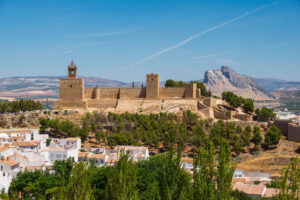
Antequera is not just beautiful on the outside: it is one of the places with the most things to see in the whole province. A well-preserved historic centre, an Alcazaba with impressive views, the Dolmens (a UNESCO World Heritage Site), the Peña de los Enamorados outlined on the horizon and, nearby, El Torcal and Fuente de Piedra Lagoon. As a town to visit in Malaga, it easily fills a whole day.
How to explore it without wearing yourself out
The old town is on a slope, and walking up to the Alcazaba at midday in summer is not a good idea. This is the order we recommend:
- Start with the Dolmens: they are on the outskirts, the visit is short and entry is free.
- Go up to the Alcazaba and the Royal Collegiate Church of Santa María: the views from the top justify everything.
- Walk down towards the centre: Plaza de San Sebastián, central streets and lunch in one of the bars serving local produce.
You can also enjoy the excellent gastronomy Antequera has to offer. Porra antequerana is the local version of salmorejo, but thicker and with a different flavour. You will find it in almost every bar in the centre. Bienmesabe, a traditional dessert, is also very typical.
The perfect plan: combine Antequera with Laberintus Park
If you visit Antequera with enough time (a full day or a weekend), the combination that works best, especially with children, is to link it with Laberintus Park, just 15 minutes away by car in Humilladero. The reason is simple: Antequera is a town full of culture, monuments and historic streets (perfect for adults), and the Laberintus leisure park provides the playful element that younger children appreciate, making it a wonderful plan for children in Malaga
The plan that works best:
- Cultural morning in Antequera: Dolmens (free), Alcazaba and Royal Collegiate Church. Allow 3-4 hours to do it without rushing.
- Lunch in the centre: porra antequerana, local produce, no rush.
- Afternoon at Laberintus Park: the plant maze, play areas and family activities offer 2-3 hours of total disconnection. Children get back to the car tired, and adults do too.
If the heat is intense, it is worth reversing the order: start the morning at Laberintus Park while it is still cool, eat near the park or on the way, and spend the afternoon in Antequera from 17:00 onwards, when the heat drops and the light for photos is much better.
What is around Antequera
The Antequera region brings together several plans that can be linked perfectly over a weekend without getting in the car three times:
- El Torcal de Antequera: a unique karst landscape in Europe, 20 minutes from the centre. A must if you are travelling with children over 4 years old.
- Fuente de Piedra Lagoon: a wetland with pink flamingos, especially spectacular between February and June.
- Laberintus Park: the most different outdoor plan in the whole region, with its plant maze as the main attraction. It combines perfectly with any of the above.
- Archidona: with its octagonal square, unique in Spain.
- Humilladero: the most authentic town in the region and the ideal base for visiting Laberintus Park.
| Fact | Detail |
| Where | Antequera region, inland Malaga |
| Distance from Malaga | Approx. 50 km / 45 min by car |
| Recommended duration | Full day if including the Dolmens and surrounding area |
| Must-see | Dolmens (free), Alcazaba, Royal Collegiate Church, historic centre |
| Parking | Several car parks near the centre |
Júzcar: the blue village of Malaga (yes, really blue)
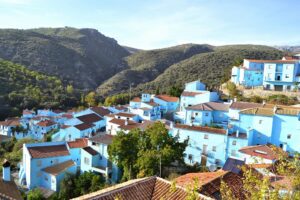
Júzcar is the exception on this list. In 2011, Sony chose this village in the Serranía de Ronda to present The Smurfs film and, in exchange, painted all its façades blue. The idea was to restore the white afterwards, but the village voted in a referendum to keep the colour and, since then, it has been the only blue village in Andalusia.
Is it worth the detour?
Honestly, it depends. If you are going with children, yes: the visual surprise is very strong and they usually love it. If you are looking for a traditional white village, this is not it. As an extra stop on a route through the Serranía de Ronda, it works very well; as a single destination, it falls a little short. The village itself can be visited in one hour.
The most interesting option is to combine it with a walk in the surrounding area (it is a good hiking area) or with a visit to other nearby villages such as Cartajima or Parauta.
| Fact | Detail |
| Where | Genal Valley, Serranía de Ronda |
| Distance from Malaga | Approx. 130 km / 1h 50 min by car |
| Recommended duration | 1 to 2 hours (longer if hiking) |
| Must-see | Walk around the village without rushing, Church Square, wander the streets |
| Parking | At the entrance to the village, free |
| Combine with | Ronda, other villages in the Genal Valley |
Casares: the beautiful Malaga village hanging from the mountain
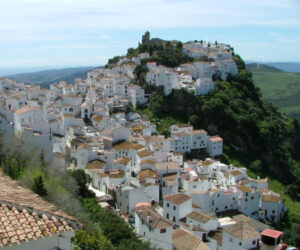
There is a typical photo of Casares that appears in every travel report: the white houses stepped along the hillside, crowned by the ruins of the Arab castle. In person, it is even more impressive than in the photo, especially if you arrive at sunset and catch the good light.
What you should know before going
Casares is higher than it seems and the road up from Estepona has quite a few bends. If someone gets carsick, it is worth knowing in advance. Once at the top, parking is at the entrance and the rest of the village is explored on foot. The good part: the views can be enjoyed from almost anywhere. The less good part: there are serious slopes.
It is the birthplace of Blas Infante, considered the father of the Andalusian homeland. If you are interested in history, his birthplace is open as a museum and the visit is short and very well explained.
Ardales: the charming town near the Caminito del Rey
Almost nobody goes to Ardales for Ardales itself: most people arrive because they are doing the Caminito del Rey or passing through the Guadalhorce Reservoir area. And they miss a very beautiful, peaceful white town, with an old quarter of Arab origin that preserves steep streets, whitewashed houses and a Mudéjar church that is well worth seeing.
The plan we recommend
If you are going to do the Caminito (reminder: minimum age 8, booking required), take advantage after finishing the route to go up to the town, have lunch on a terrace in the centre and rest. Afterwards, you can go back down to the reservoir and, if there is still light, take a walk around the Desfiladero de los Gaitanes area. That “route + town + lake” format works very well.
Another option is to go to Ardales without doing the Caminito. The town itself has a pleasant walk and views, and the Ardales Lakes are one of the most beautiful spots in inland Malaga, with areas suitable for swimming in summer.
| Fact | Detail |
| Where | Guadalteba region, inland |
| Distance from Malaga | Approx. 60 km / 1h by car |
| Recommended duration | 2 to 3 hours for the town; full day with the Caminito or lakes |
| Must-see | Historic centre, Nuestra Señora de los Remedios Church, Ardales Lakes |
| Parking | Bullring and designated areas in the town |
| Combine with | Caminito del Rey, Guadalhorce Reservoir, Carratraca |
 Tips for planning a route through the most beautiful towns in Malaga
After doing many routes (and getting many others wrong), these are the rules that really work:
- One main town per day. Two at most if they are less than 20 minutes apart. More than that means driving, rushing and few real memories.
- Always park outside the centre. Especially in Frigiliana, Mijas and Ronda. GPS apps take you into impossible streets if you do not enter the specific car park yourself.
- Eat before 14:30. In small towns, kitchens close earlier than in the capital. Eating late can leave you with no options.
- Real heat in July and August. In inland white villages, temperatures easily exceed 35-38 °C. Either get up early or go after 18:00.
- Combine the town with an extra plan. A short route, a cave, a park, a viewpoint. The town alone can sometimes feel too short.
- Comfortable footwear, always. Cobbled streets and slopes are the norm in almost all white villages.
Conclusion: which towns to visit in Malaga depending on your type of trip
Malaga province is lucky enough to offer very different towns less than an hour and a half from the capital: classic white villages, villages hanging from mountains, towns with gorges, blue villages, coastal towns and authentic inland towns. The trap, as with any route, is wanting to see them all on a short getaway.
If you have time and choose just one region, you will enjoy it much more: Axarquía (Frigiliana + Cómpeta), Serranía de Ronda (Ronda + Júzcar), Costa del Sol (Mijas + Casares) or Antequera and its surroundings (Antequera + Fuente de Piedra + Laberintus Park) are combinations that really work.
And if you are travelling with children, remember that we have a dedicated guide to plans with children in Malaga with the same philosophy: no endless lists, just what really works.
Frequently Asked Questions about beautiful towns in Malaga
The eight beautiful towns in Malaga that are most worth visiting are Frigiliana, Ronda, Mijas Pueblo, Antequera, Júzcar, Casares, Cómpeta and Fuente de Piedra. Each one suits a different profile: classic white village, town with a gorge, coastal town, cultural town, blue village, mountain village, wine village and the town of the flamingo lagoon.
The most recommended white villages in Malaga are Frigiliana, Mijas Pueblo, Casares, Cómpeta and Ardales. They all share the classic Andalusian style of whitewashed façades and narrow streets, but with very different personalities: Frigiliana is the most photogenic, Mijas the easiest to visit, Casares the most spectacular in terms of location, Cómpeta the most authentic and Ardales the best combined with nature.
There is no single answer, but Frigiliana usually appears on almost every list of the most beautiful villages in Spain, thanks to its Moorish quarter and cobbled streets. Other towns such as Casares or Ronda stand out for their spectacular location. For a quick and easy visit, Mijas Pueblo is hard to beat.
The most convenient towns in Malaga to visit with young children are Mijas Pueblo, thanks to its pedestrian and fairly flat layout; Antequera, because it can be combined with the Dolmens, El Torcal and Laberintus Park; Fuente de Piedra, ideal in spring for watching flamingos in its lagoon; and Júzcar, because of the visual surprise of its blue façades. Ronda is better with children over 7-8 years old because of the distances within the town.
Júzcar is the only blue village in Malaga (and in Andalusia). Its façades were painted blue in 2011 for the presentation of The Smurfs film and, after a local referendum, the residents decided to keep the colour. It is located in the Serranía de Ronda and the visit combines well with other villages in the Genal Valley.
The best options for a day trip from Malaga city are Frigiliana (combined with Nerja), Mijas Pueblo (combined with some time on the coast), Antequera (combined with the Dolmens and El Torcal) and Fuente de Piedra (combined with Laberintus Park and its flamingo lagoon). They are all less than an hour away and allow for a relaxed plan without needing to stay overnight.
Spring (March-May) and autumn (September-November) are the best seasons to explore the beautiful towns in Malaga: mild temperatures, fewer tourists and ideal light for photos. In summer, especially in July and August, it is best to visit first thing in the morning or after 18:00 because of the heat. In winter, the inland towns can be cold but are practically empty, which has its own charm.
Yes, but it is best to limit yourself to two nearby towns per day. Recommended combinations include Frigiliana + Nerja, Antequera + Fuente de Piedra, Mijas + Fuengirola or Ronda + Júzcar. Trying to fit three or more towns into one day usually means spending more time in the car than enjoying the trip, especially with children or older people.